Systematic literature review
After this session, you should be able to:
Undertake critical and systematic literature review relating to a topic of interest.
- EndNote: Used extensively in academic and professional settings.
- Zotero: An open-source reference management system.
- Mendeley: This tool facilitates the organization of PDFs as well as collaboration with other researchers.
- RefWorks: Web-based reference management tool.
- Systematic and critical study to:
- Identify
- Assess
- Interpret
- previous work (themes, debates & gaps) related specific project topic
- An overview of the chosen literature which identifies the main positions or themes
- Discovers and establishes links between the sources (themes)
- compares and contrasts them
- evaluates their strengths and weaknesses
- identifies theories, concepts, frameworks or techniques that will be useful to your research
- Overview of a topic for
- Ideas, theories and hypotheses
- Methodologies
- Findings
- Demonstration of a base for your own work – i.e. your added value
- Establish what previous research has done (you don’t ‘reinvent the wheel’).
- To point out what current research has not yet investigated
- For yourself, your project aims to fill this gap in knowledge; knowing what you can do
- For others, serves as justification for a project
- A bad review = a bad project! Guaranteed!
- A literature review is a review of
- Only academic (peer-reviewed) articles!
- Published in
- Academic journals (e.g. Journal of Finance) or
- Unpublished working papers
- available from e.g. SSRN, ethos
- No newspapers, magazines, internet sources, etc……
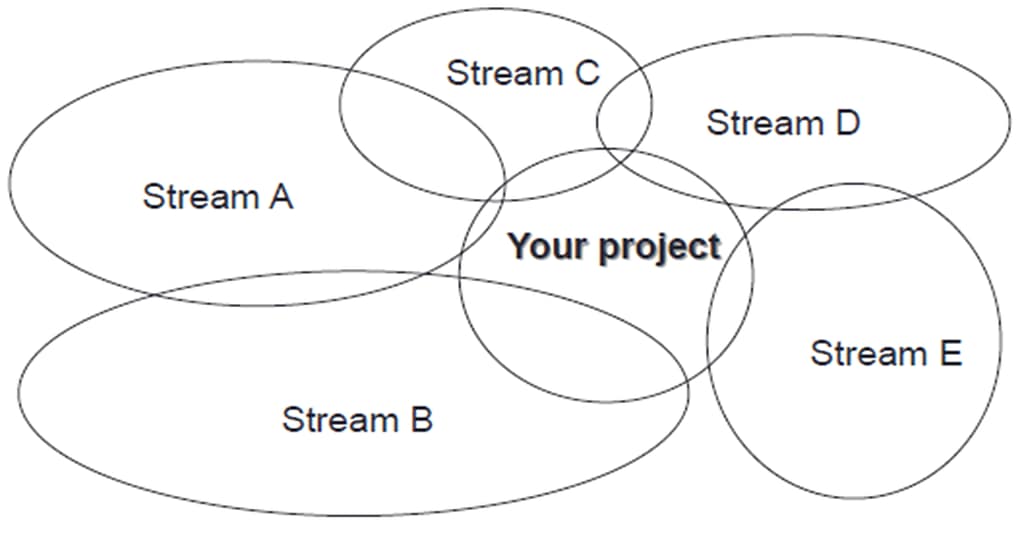
- What is the key literature underpinning your research?
- Contextualise your review
- Establish the relationship to previous work by demonstrating that you are aware of the up-to-date research topics and key research findings.
- No ‘re-inventing the wheel’.
- Avoiding unnecessary duplication of effort.
- If a solution, theory, or framework already exists and is effective, there is no need to create something entirely new.
- Instead, you should adapt, refine, or build upon what is already available
- No study in a vacuum/detached from existing knowledge.
- research or study should always be connected to the broader body of knowledge in the field.
- Every new study should acknowledge and engage with past research, theories, and findings.
- Ignoring existing literature can lead to redundant or irrelevant work while integrating prior knowledge ensures meaningful contributions to the academic or professional community
- Demonstrating how you intend to build on what is known by grounding your research in secondary materials
- acknowledging the works of others is a good indication of quality review.
While studying “The impact of religiosity on earnings quality: International evidence from the banking sector”, we highlighted in the introduction that:
Previous researchers have shown that high levels of religiosity affect managers and the organisations they control (Leventis, Dedoulis, & Abdelsalam, 2018; Longenecker, McKinney, & Moore, 2004; McCullough & Willoughby, 2009; McGuire, Omer, & Sharp, 2012; Vitell, 2009; Abdelsalam, Duygun, Matallin-Saez & Tortosa-Ausina, 2017) since religious norms convert emotions of guilt and shame into a sense of accountability among actors, directing them towards choosing ethical decision making. However, a few questions remain unexplored: (a) Does earnings quality differ between countries where religion is part of the national identity and therefore adherence is more pronounced? (b) Does the impact of religiosity on earnings quality differ between countries in accordance with the strength of formal institutions? (c) Does the impact of religiosity on earnings quality differ during a crisis period? Our paper aims to fill these gaps.
Reconstruct objectives into themes
1. Social norms and banks’ earnings quality – theory building
2. Religiosity, national identity and banks’ earnings quality – objective 1/question 1
3. Religiosity, formal institutions and banks’ earnings quality – objective 2/question 2
4. Religiosity, crisis and banks’ earnings quality – objective 3/question 3
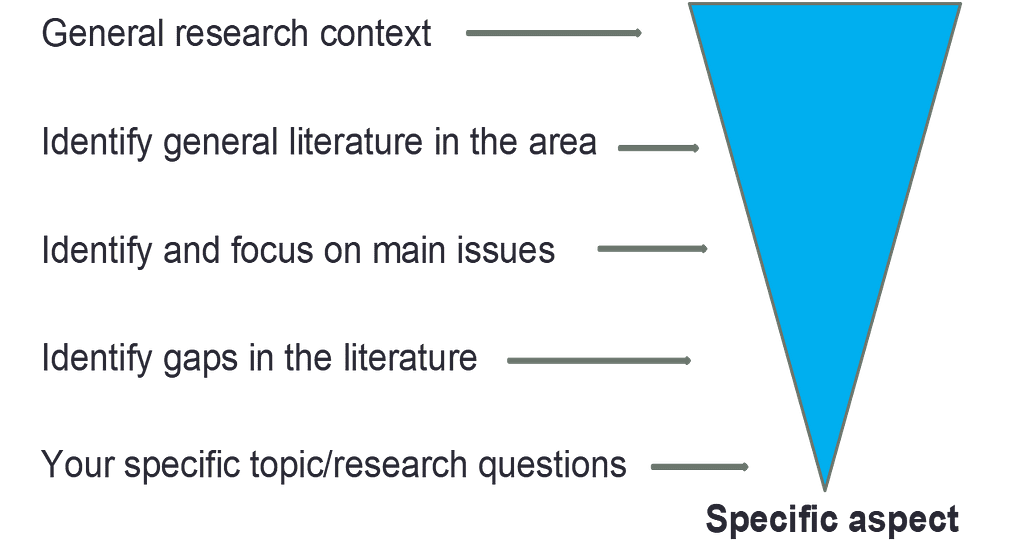
- Keywords
- Identify and define key terms and concepts
- Parameters
- Time Frame
- Specify the publication period (e.g., 2010–2025).
- Why? To capture recent and relevant research.
- Language
- Commonly English, but can include other languages if relevant.
- Why? Language restrictions affect comprehensiveness.
- Subject
- Example: Accounting and Finance.
- Why? Ensures focus on the discipline.
- Sector/Industry
- Example: Banking, Insurance, Manufacturing.
- Why? Contextualises findings.
- Firm Type
- Example: SMEs, family-owned, multinational corporations.
- Why? Different firm types have unique characteristics.
- Geographical Focus
- Example: UK, France, Global.
- Why? Regulatory and cultural differences matter.
- Literature Format
- Example: Peer-reviewed journals, books, conference papers.
- Why? Ensures quality and credibility.
- Time Frame
- Search for appropriate articles, works and reports
- Academic/review articles, governmental/industry reports
- Read it carefully – be focused!
- make notes and structure them
- organise concepts and links
- Identify important features/issues and categorise
- Arguments
- Evidence
- Evidence collection
- Evaluate arguments, evaluate evidence, check logic
- Identify gaps: angles, issues, and themes that are not or poorly covered in the existing literature
- Context – focus in story-telling
- Search backwards in time – guided by the timeframe; start from broad to specific;
- Organise the structure in accordance with your objectives
- You may consider the use of software packages, such as RefWorks, Mendeley etc.
- Move from keyword searches to identifying the best types of sources – especially journals
- Highlight the issues as reflected by authors and not vice-versa (avoid descriptive review)
- Analyse the context and issues
- Draw up a conclusion based on your interpretations
- Nowadays – use Nvivo for organising and querying literature sources.
| Critical analysis | Non-critical analysis |
| – Exploring context/arguments and differences in studies – Exploring differences and reasons in the findings of studies – Establishing the relevance of concept definitions to your own topic – Critiquing studies based on approach, methods, and findings with a view to establishing gaps – Interpreting studies based on knowledge of other literature – Justifications… | – Description of a study – Fact presentation – Speculative statement(s) – might/may …. – Listing of studies – Missed (improper) evidencing |
]Bryman, A. and Bell, E., (2011) Business Research Methods, 3rd edition, Oxford: Oxford University Press.
Bryman. A (2012) Social Research Methods, 4th edition, Oxford: Oxford: University Press
Hart, C. (1999) Doing a Literature Review: Releasing the Social Science Research Imagination, London: Sage.
Robert K. Yin, R.K. (2018), Case study research and applications: design and methods, 6th Edn, Los Angeles: SAGE .
Saunders, M.N.K., Lewis, P., and Thornhill, A. (2023), Research methods for business students, 9th Edn, Harlow: Pearson
Wilson, J. (2014). Essentials of business research: A guide to doing your research project , 2nd Edn. SAGE Publications.